

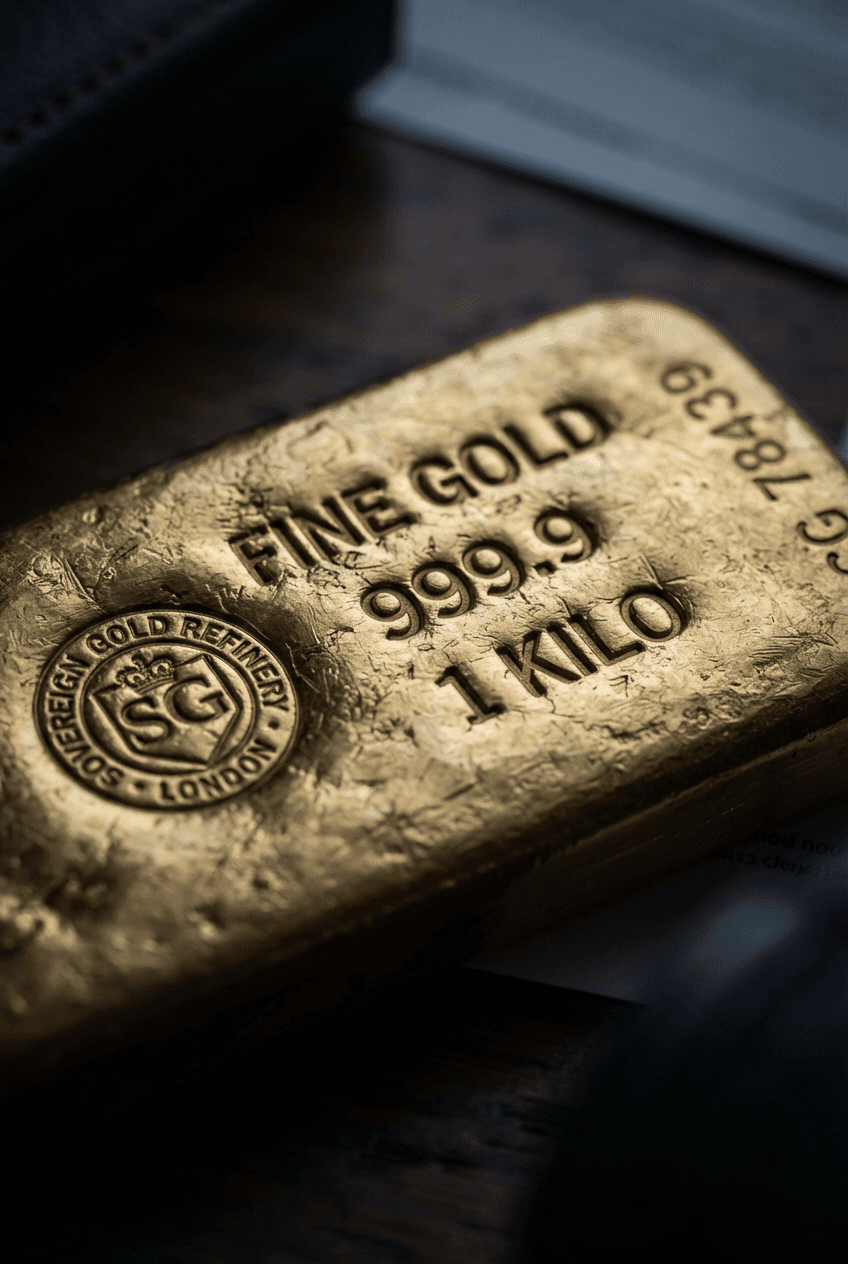
Reading the assay: what 999.9 really guarantees
Four nines fine is a chemistry claim, an audit claim, and a chain-of-custody claim — and each one is proven differently. A walk through what an assay card actually attests to.
Big Deal
Refining floor lead
There is a temptation to treat 999.9 as a marketing number — the highest available fineness, printed on the bar in a font that is one point larger than the weight. It is, but it is also three overlapping claims. Reading an assay card properly means understanding which of them is being made.
Claim one: the chemistry
999.9 fine means the metal is 99.99% gold by mass, with the remaining 100 parts per million distributed across silver, copper, palladium, and trace elements. Verifying this requires a fire assay — a physical separation of the gold from base metals under high heat, followed by a weighing of the resulting cupelled bead. XRF, the handheld surface scanner most dealers own, is useful for triage but does not qualify as a definitive assay for LBMA-grade material. The paperwork should record which method was used, and on which sample.
Claim two: the audit
The second claim is that the specific bar in your hand belongs to a specific melt — a specific pour of a specific crucible on a specific date. This is the serial number's job. A serialized bar without a corresponding lot record is a piece of stamped metal, not an audited asset. On a properly certified bar, the serial should tie back to a melt certificate, and the melt certificate should show the input material, the assay result, and the operator on the floor at the time of pour.
Claim three: the chain
The third claim is the one that gets glossed over most often: that between the pour and your hand, the piece has been in a documented chain of custody. This is why LBMA Good Delivery bars are worth what they are — the market trusts the transit as much as the metal. For retail-scale investment bars, the tamper-evident assay card serves the same function: if the seal is intact, the piece has not been touched since its final inspection.
- Fire assay on the melt, XRF as a spot check on the finished bar.
- Serial number tied to a lot record on the floor, not just stamped on the face.
- Tamper-evident card with a matching serial that must be broken to remove the bar.
None of this is unusual — it is what any properly run refinery does. But it is worth naming, because the difference between a 999.9 fine bar and a 999.9 fine bar with all three claims properly attested is roughly the difference between owning a piece of gold and owning a piece of the bullion market.
KEEP READING
More from the atelier

Craft
11 May 2026 · 9 min read
From granulate to bar: a walkthrough of the atelier floor
A step-by-step look at how a batch of high-purity granulate becomes a serialized, hallmarked, tamper-evident investment bar — and where the human judgment sits.

Policy
22 July 2026 · 6 min read
How Singapore's IPM tax exemption anchors the region's bullion demand
Since October 2012, Investment Precious Metals have been exempt from GST in Singapore — the quiet policy lever that turned the city into an Asian bullion hub.

Market
19 June 2026 · 7 min read
Gold's role in a defensive Singapore portfolio
A practical view on how physical bullion sits alongside cash, SGS bonds, and equities in a Singapore-dollar-denominated portfolio — and where the friction points are.